
Note: Same Day Emergency Care (SDEC)
In 2023, NHS England (NHSE) announced a methodological change to require Trusts to report Same Day Emergency Care (SDEC) to the Emergency Care Data Set (ECDS) by July 2024. Some Trusts had previously reported this activity as part of the Admitted Patient Care data set. Both the Conquest Hospital and Eastbourne District General Hospital began to report SDEC to ECDS in the year 2024 to 2025 this may reduce the number of admissions reported and the rate of admissions.
NHSE have advised it is not possible to accurately identify SDEC in current data flows, but the impact of the change is expected to vary by diagnosis, with indicators related to injuries and external causes potentially most affected.
Definitions
There are three indicators on childhood injury included in the Public Health Outcomes Framework (PHOF). They are the rate of hospital admissions caused by unintentional and deliberate injuries in children and young people across three age categories: 0-4, 0-14 and 15-24 years. For children aged between 0-4 years very few injuries are caused by deliberate causes the vast majority of injuries are caused by unintentional causes.
The term ‘unintentional and deliberate injuries’ is used rather than ‘accidents’, since most injuries are predictable and preventable. In contrast, the term ‘accident’ implies an unpredictable and therefore, unavoidable event.
The use of the terms ‘unintentional injuries and deliberate injuries’ also acknowledges that children and young people experience a range of risks as they age and develop:
- Unintentional injuries are identified as external causes of harm, such as, road traffic collisions, sports injury, falls, accidental contact with machinery, burns and drowning etc.
- Deliberate injuries include different types of assaults and deliberate self-harm.
Specifically, the PHOF indicators relate to emergency admissions to hospital which include one or more codes for injuries in the diagnosis fields of the hospital electronic record. The data is sourced from Hospital Episode Statistics (HES). All subnational counts (admissions and patients) are rounded to the nearest 5 (as per the Hospital Episode Statistics user agreement).
The codes are contained within the International Classification of Disease 10 (ICD-10) and are:
- S00-T79 (injuries, poisoning and burns)
- V01-V99 (road traffic accident)
- W00-X59 (other causes of accidental injury)
- X60-X84 (intentional self-harm)
- X85-Y09 (assault)
- Y10-Y34 (events of undetermined intent)
- Y35-Y36 (legal interventions and operations of war)
Unless otherwise stated the data source is Hospital Episode Statistics (HES), NHS England, accessed by East Sussex Public Health.
Hospital admissions
- For over 10 years East Sussex has had a significantly higher rate of hospital admissions due to unintentional and deliberate injuries in under 5s compared to England.
- The rate of admissions for both England and East Sussex has shown a decreasing trend in recent years.
Chart 1: Hospital admissions caused by unintentional and deliberate injuries in children (aged 0 to 4 years) – per 10,000
Source: Office for Health Improvement & Disparities. Public Health Profiles. 2025 https://fingertips.phe.org.uk © Crown copyright 2025
- In 2023/24, out of all the upper tier local authorities in the South East region (19), East Sussex ranked 2nd for the rate of admissions due to unintentional and deliberate injuries.
- In 2023/24, Hastings had the highest rate in the South East (Rother ranked 4th, Eastbourne ranked 7th, Lewes ranked 12th and Wealden ranked 20th out of 64 lower tier local authorities in the South East).
- In 2023/24 Hastings ranked 4th in England (out of 294 local authorities).
- In 2024/25 there were 260 children under 5 in East Sussex admitted to hospital as a result of unintentional or deliberate injuries.
- Over the last five years the location of where the injury occurred has been recorded in 74% of admissions.
- Of those where location is known and specified, 86% occurred at home for under 1s, 81% for 1 and 2 year olds and 56% for 3 and 4 year olds.
- Over the last five years, 85% of children were admitted once.
Table 1: Length of stay 5 years pooled 2020/21 to 2024/25, East Sussex
| Length of stay | Number of admissions | Percentage of admissions |
| 0 day spells | 1,125 | 70% |
| 1 day spells | 325 | 20% |
| 2 days spells | 70 | 4% |
| 3+ day spells | 80 | 5% |
- The majority of admissions (70%) resulted in a zero length stay (discharged on the same day of admissions).
Map 1: Admissions due to unintentional and deliberate injuries, 0-4 year olds, East Sussex MSOAs, 2020/21 to 2024/25
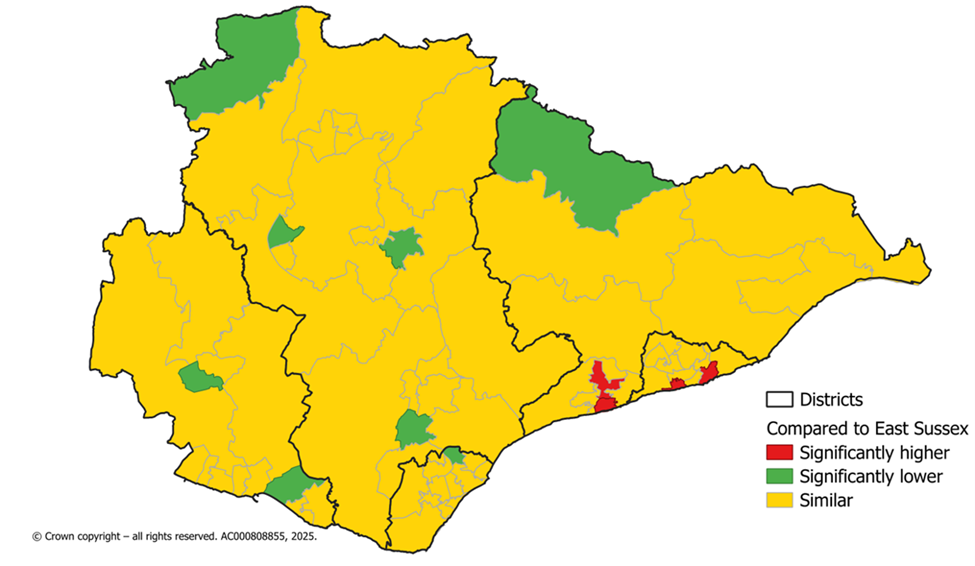
- The MSOAs with highest rate of admissions (data combined over five years, 2020/21 to 2024/25) are (highest rate first): Bexhill Central, Old Hastings, Bexhill North & Sidley and Central St Leonards.
Chart 2: East Sussex rate of admissions due to unintentional and deliberate injuries under 5s by deprivation, 2020/21 to 2024/25
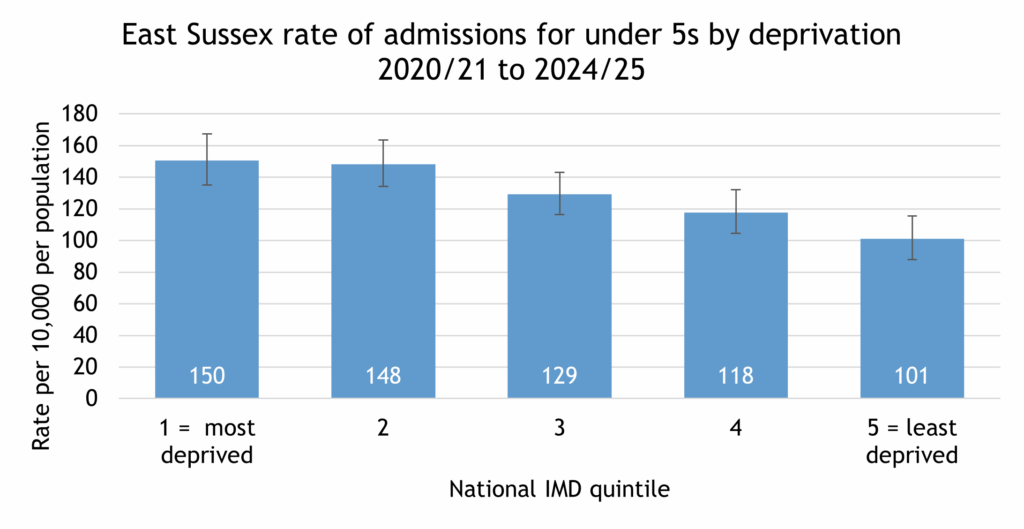
- Rate of admissions increases with increasing deprivation.
Chart 3: Admissions due to unintentional and deliberate injuries by age group – counts (2015/16 to 2024/25)
Chart 4: Rate of admissions by age group (per 10,000 population), 2015/16 to 2024/25
- In the latest year (2024/25) the rate of admissions is highest in the under 1s and lowest in children aged 3-4 years.
Table 2: Admission cause (where n >10) 0-4 year olds – 2020/21-2024/25
| Cause | 5 year admission count |
| Falls | 680 |
| Exposure to inanimate mechanical forces | 305 |
| Accidental exposure to other and unspecified factors | 145 |
| Accidental poisoning by and exposure to noxious substances | 115 |
| Exposure to animate mechanical forces | 80 |
| Contact with heat and hot substances | 45 |
| Other accidental threats to breathing | 20 |
| Pedal cyclist injured in transport accident | 15 |
| Car occupant injured in transport accident | 15 |
| Pedestrian injured in transport accident | 10 |
| Total (including other causes not shown) | 1,490 |
- Falls are the main reason for admissions across all age groups. However, there are differences in the type of fall that causes the highest number of admissions for different age groups. In under 1s most falls admissions are due to falls while being carried or supported by other persons. For 1 to 2 year olds most falls admissions are due to falls on and from stairs and steps, and for 3 to 4 year olds it is due to falls on same level from slipping, tripping and stumbling.
Table 3: Top five causes of admissions by age group – 2020/21 – 2024/25
| Rank | Under 1s | 1-2 years | 3-4 years |
| 1 | Falls (n=140) | Falls (n=315) | Falls (n=225) |
| 2 | Accidental exposure to other and unspecified factors (n=50) | Exposure to inanimate mechanical forces (n=145) | Exposure to inanimate mechanical forces (n=125) |
| 3 | Exposure to inanimate mechanical forces (n=30) | Accidental poisoning by and exposure to noxious substances (n=70) | Accidental exposure to other and unspecified factors (n=40) |
| 4 | Accidental poisoning by and exposure to noxious substances (n=15) | Accidental exposure to other and unspecified factors (n=55) | Exposure to animate mechanical forces (n=35) |
| 5 | Exposure to animate mechanical forces (n=10) | Exposure to animate mechanical forces (n=35) | Accidental poisoning by and exposure to noxious substances (n=30) |
Table 4: Cause = fall (where n > 10) under 1s – 2020/21 – 2024/25
| Type of fall | 5 year admission count |
| Fall while being carried or supported by other persons | 35 |
| Fall involving bed | 25 |
| Fall involving chair | 15 |
| Fall on and from stairs and steps | 15 |
| Fall involving other furniture | 15 |
Table 5: Cause = fall (where n > 10) 1 and 2 year olds 2020/21 – 2024/25
| Type of fall | 5 year admission count |
| Fall on and from stairs and steps | 50 |
| Fall on same level from slipping, tripping and stumbling | 45 |
| Unspecified fall | 40 |
| Other fall on same level | 40 |
| Fall involving other furniture | 30 |
| Fall involving chair | 30 |
| Fall involving bed | 25 |
| Fall involving playground equipment | 20 |
| Other fall from one level to another | 20 |
Table 6: Cause = fall (where n > 10) 3 and 4 year olds 2020/21 – 2024/25
| Type of fall | 5 year admission count |
| Fall on same level from slipping, tripping and stumbling | 45 |
| Fall involving playground equipment | 35 |
| Unspecified fall | 30 |
| Other fall on same level | 25 |
| Other fall from one level to another | 15 |
| Fall involving furniture | 15 |
| Fall on and from stairs and steps | 15 |
| Fall involving bed | 15 |
| Fall involving chair | 15 |